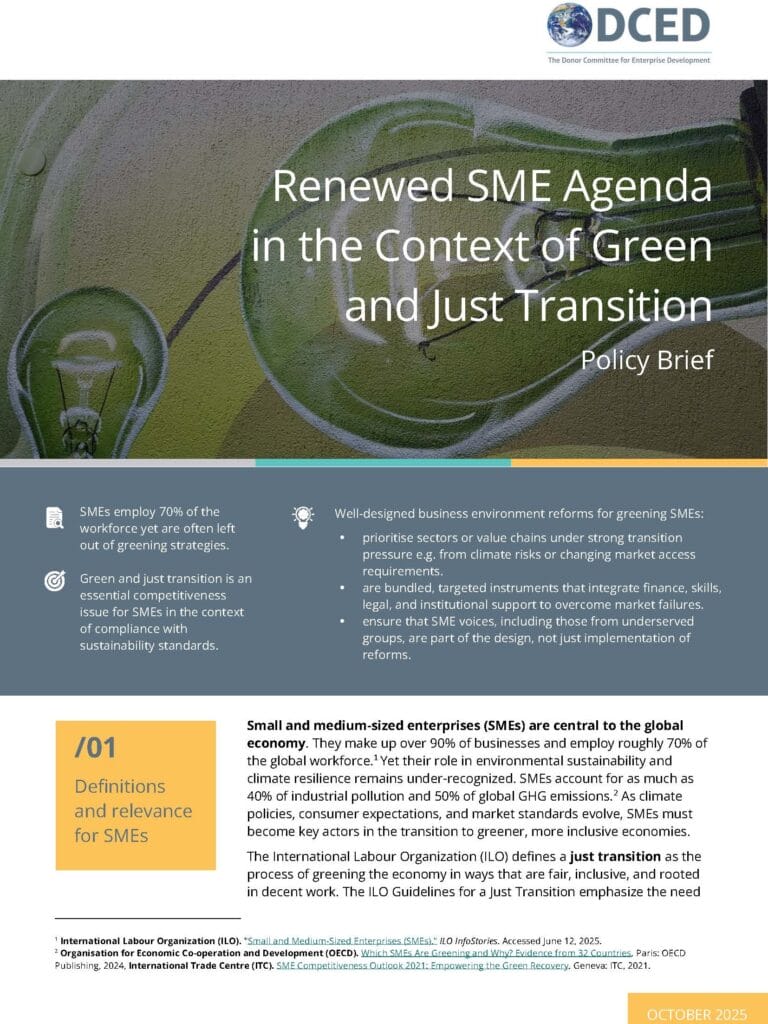
The DCED established the Business Environment (BE) Community of Practice (formerly BE Working Group) in 2002 to share knowledge on donor-supported business environment reform (BER) in developing countries and to support good practice and new approaches. The BE CoP helps agencies and their programme partners to position business environment reform (BER) effectively as part of an integrated private sector development strategy and to enhance the synergies between these reforms and broader development objectives.
The DCED defines the business environment as a complex of policy, legal, institutional, and regulatory conditions that govern business activities. It is a subset of the investment climate and includes the administration and enforcement mechanisms established to implement government policy, as well as the institutional arrangements that influence how key actors operate (e.g., government agencies, regulatory authorities, and business membership organisations, and trade unions).
The BE Community of Practice is chaired by the World Bank Group and GIZ.
Current priority themes
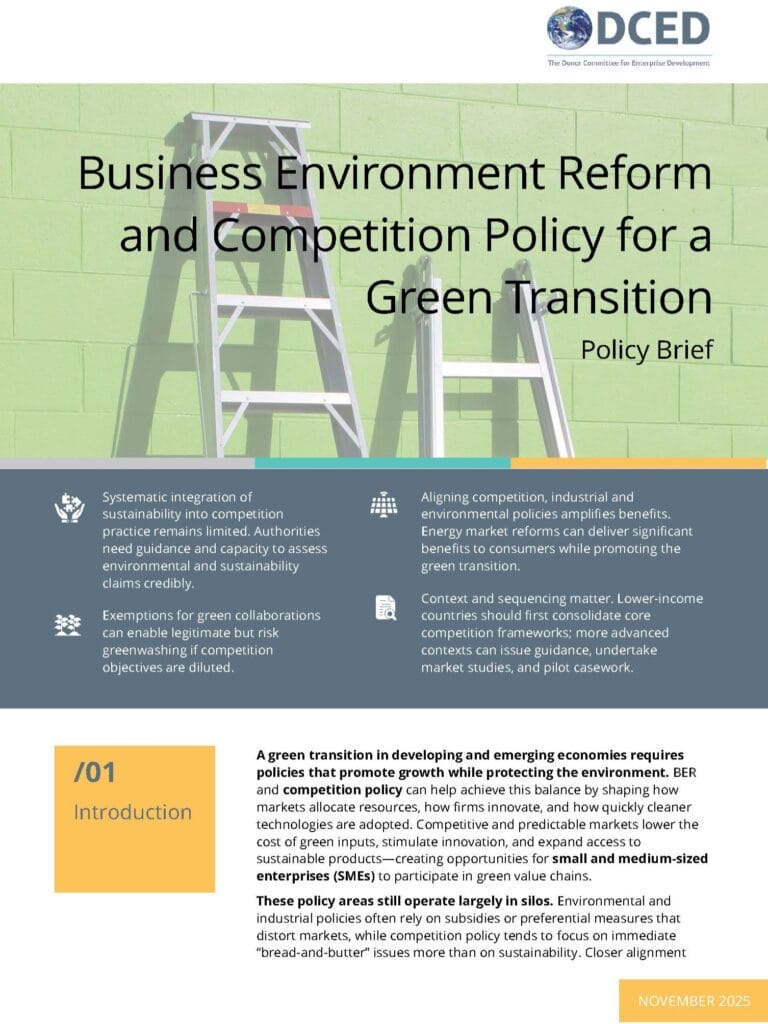
Most recently, the BE CoP has focused on reviewing experience and developing practical guidelines on the use of business environment reform towards a range of priority objectives among DCED members, notably green private sector development, private capital mobilisation and inclusion of informal and women-owned businesses (see the publications listed below).
Current activities focus on
Studying the role of trade corridor initiatives in inclusive economic development
Reviewing lessons in how economic zones, including industrial parks, can contribute to wider changes in partner countries’ economic systems
Disseminating knowledge generated through recent publications related to BER for green outcomes and private capital mobilisation
Collaborating with other DCED Communities of Practice in reviewing experiences in achieving mutual benefits for donor and partner countries through donor-funded BER and other PSD programming
Continuing to hold peer learning sessions on recent trends and challenges in BER programming.
Publications
Publications of the Business Environment CoP are listed below. For curated resources on the topic by other organisations, please refer to the DCED knowledge page:
Review the decisions, action items and discussion summaries of the Business Environment CoP below. This includes meeting minutes and associated materials since its creation in 2015 and DCED member exchanges on the topic.
This website uses cookies to store information on your computer. You may block cookies from this site, but disabling cookies will prevent us from monitoring site usage which helps us make improvements to the site. Read more about how we use cookies.COOKIE SETTINGSACCEPT
Privacy & Cookies Policy
Privacy Overview
This website uses cookies to improve your experience while you navigate through the website. Out of these cookies, the cookies that are categorized as necessary are stored on your browser as they are essential for the working of basic functionalities of the website. We also use third-party cookies that help us analyze and understand how you use this website. These cookies will be stored in your browser only with your consent. You also have the option to opt-out of these cookies. But opting out of some of these cookies may have an effect on your browsing experience.
Necessary cookies are absolutely essential for the website to function properly. This category only includes cookies that ensures basic functionalities and security features of the website. These cookies do not store any personal information.
Any cookies that may not be particularly necessary for the website to function and is used specifically to collect user personal data via analytics, ads, other embedded contents are termed as non-necessary cookies. It is mandatory to procure user consent prior to running these cookies on your website.