Private sector development (PSD) represents a powerful way to address gender inequalities and to empower women economically and socially. At the same time, engaging women in productive employment is proven to have economy-wide benefits.
The Women’s Economic Empowerment Working Group (WEE WG) aims to harness the knowledge and experience of DCED member agencies to integrate gender and WEE considerations more strategically and effectively into their work. Ultimately, it seeks to enhance the economic development and poverty-reduction impact of PSD programmes by strengthening their knowledge, capacity and incentives to address the relevant constraints and needs of both women and men equally.
The WEE WG is currently chaired by International Development Research Centre (IDRC), Canada.
While WEE and inclusion have been mainstreamed within PSD for many years, supported by a strong economic and business case, inclusion principles are increasingly under pressure. A key priority for DCED members is to continue generating knowledge on, and promote the adoption of, effective WEE and inclusion strategies in PSD. This year, the WEE WG focuses in particular on
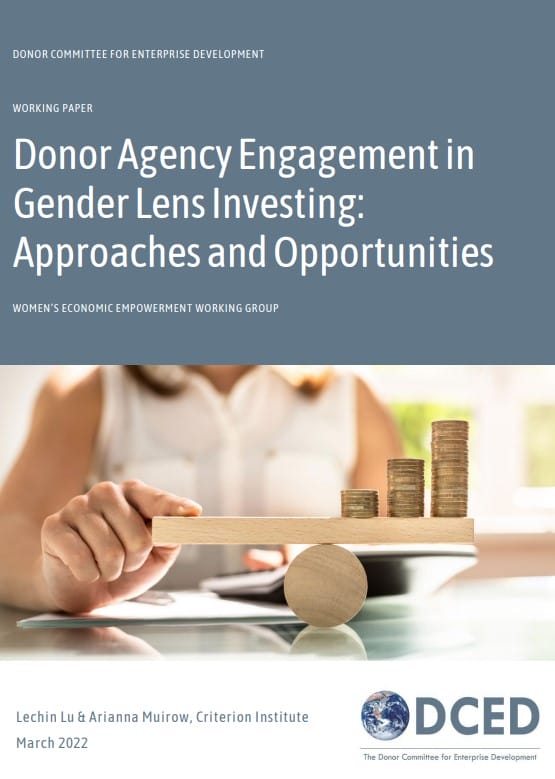
Donor engagement in gender-lens investing: Building on the group’s work over the past four years, current discussions focus on what the private investment sector needs from donor and development agencies to catalyse gender-lens investing. The task team is meeting with stakeholders from financial organisations for learning sessions to discuss the opportunities and challenges associated with a range of mechanisms and vehicles that encourage the private sector to move capital whilst taking a gender-transformative approach.
Care economy, climate change and PSD: Unpaid care work is essential yet often undervalued and disproportionately performed by women worldwide. This imbalance limits women’s economic opportunities, including access to paid and green jobs, due to time and mobility constraints. Climate change and environmental degradation further intensify unpaid care burdens, as extreme weather and resource scarcity increase caregivers’ responsibilities for food, health and displacement needs. Although climate programmes could help address or redistribute unpaid care through care-sensitive design, such examples are rare, and some interventions are even worsening these challenges. This initiative seeks to expand knowledge of the care-climate link by focusing on effective PSD policies, commissioning a research report with policy recommendations, and hosting online sessions to share results.
Peer exchange on navigating the changing global aid context: Member regularly discuss the latest developments in their agency and how programmes can continue to carve out space for WEE and inclusion in a time of changing priorities and budget cuts.
This website uses cookies to store information on your computer. You may block cookies from this site, but disabling cookies will prevent us from monitoring site usage which helps us make improvements to the site. Read more about how we use cookies.COOKIE SETTINGSACCEPT
Privacy & Cookies Policy
Privacy Overview
This website uses cookies to improve your experience while you navigate through the website. Out of these cookies, the cookies that are categorized as necessary are stored on your browser as they are essential for the working of basic functionalities of the website. We also use third-party cookies that help us analyze and understand how you use this website. These cookies will be stored in your browser only with your consent. You also have the option to opt-out of these cookies. But opting out of some of these cookies may have an effect on your browsing experience.
Necessary cookies are absolutely essential for the website to function properly. This category only includes cookies that ensures basic functionalities and security features of the website. These cookies do not store any personal information.
Any cookies that may not be particularly necessary for the website to function and is used specifically to collect user personal data via analytics, ads, other embedded contents are termed as non-necessary cookies. It is mandatory to procure user consent prior to running these cookies on your website.