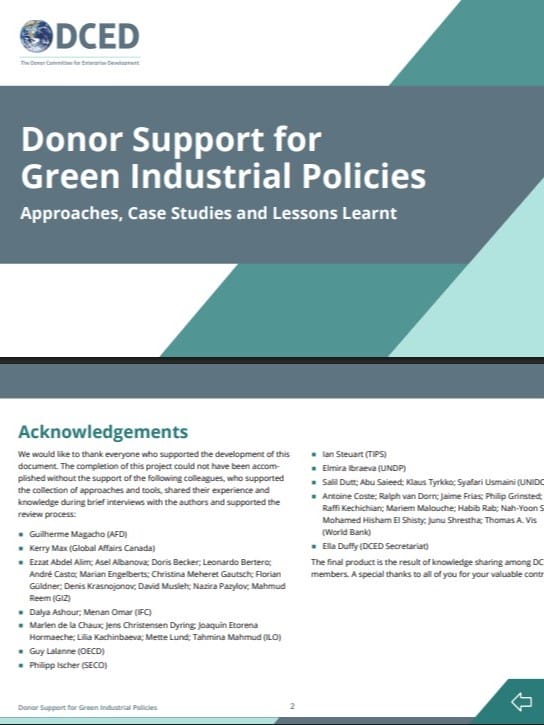
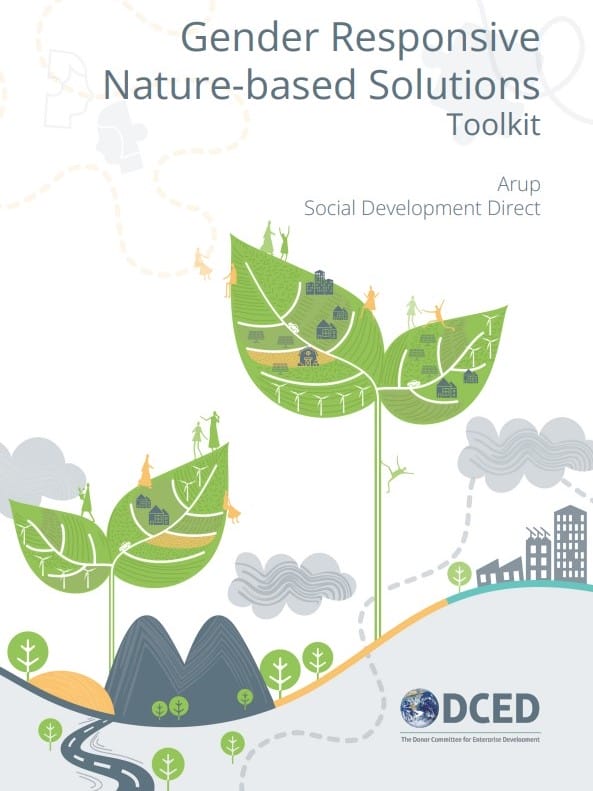
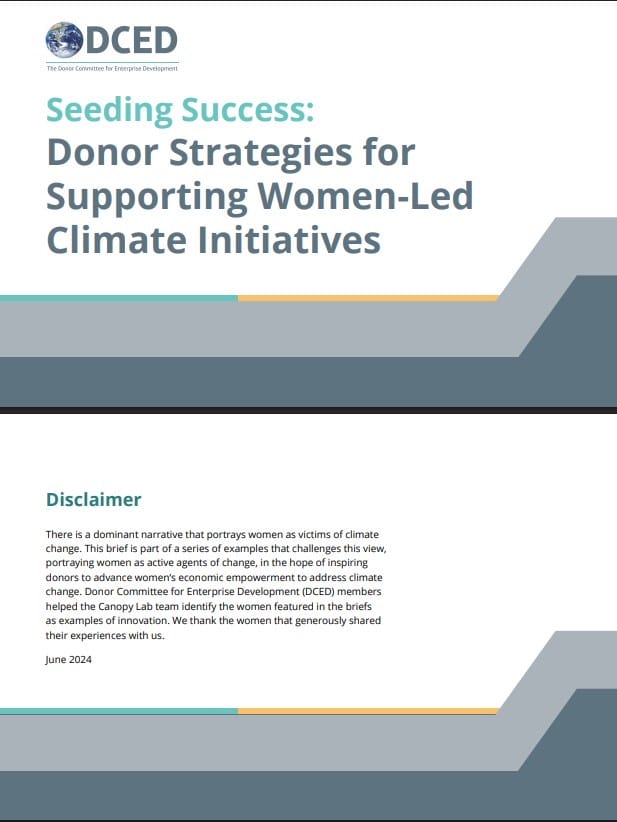
Many private sector development (PSD) policies and programmes aim to achieve green as well as economic goals, including mitigating and adapting to climate change, reducing environmental pollutants, and reversing biodiversity loss, land degradation and water scarcity. Meeting these needs can also be an opportunity for businesses and economies in the developing world. ‘Green PSD’ has a very broad scope in practice; funders and practitioners use the phrase to refer to policies and programmes covering green industries, energy transition, bioeconomy and nature-based solutions, to name a few.
The DCED’s Green Growth Working Group (GGWG) aims to harness knowledge and experience among DCED member agencies on designing green PSD policies and programmes, and to integrate ‘green’ considerations more strategically and effectively into other PSD work.
The Working Group is co-chaired by the World Bank and the International Trade Centre (ITC).
Exploring how PSD approaches can be effectively applied to deliver different ‘green’ outcomes sits at the heart of DCED’s current learning agenda., with several DCED Working Groups tackling different aspects of this complex field of work. The GG WG currently focuses on enabling policy and regulatory environments for a green and just transition, and also has a strong inclusion focus.
Current activities focus on:
The role of trade and MSME development in driving a just transition: Governments are increasingly addressing the environmental impacts of trade while supporting economic growth. New global standards and policies aim to encourage sustainable practices, but micro, small, and medium-sized enterprises (MSMEs), especially in developing countries, often struggle to meet these requirements due to limited resources. Non-compliance may lead to exclusion from supply chains. To support MSMEs’ just transition through trade, GGWG members have commissioned research to review 3-4 recent policy frameworks, focusing on their impact, inclusion, and support for MSMEs and their workers in developing countries. The group will consider consultation processes, necessary support systems, implications for enterprise development, and the potential for structural transformation.
Enabling policy frameworks for circular economy: Shifting to a circular economy benefits people and the planet. SMEs, which make up over 90% of businesses and more than half of global employment, can drive this shift by adopting efficient circular processes and introducing new products, services, technologies, and value chains. However, the influence of SMEs in circularity transitions and the effects on them and their employees are not well understood. The GGWG has commissioned research examining how SMEs support the circular economy, identifying effective policies and levers, and assessing impacts on job creation and quality, with a focus on agricultural processing in Rwanda and textiles in Colombia.
Job potential in critical minerals and clean energy technologies value chains: Many DCED GGWG members focus on clean energy, critical minerals, and decent work. This workstream aims to link these areas by examining job opportunities in clean energy technologies, particularly in midstream and downstream segments of solar PV and battery value chains. The task team currently meets regularly to share experience as demand for this work grows rapidly across many member agencies. The team will consider exploring specific research questions after this period of knowledge sharing, as, despite limited data on minerals and clean energy technology value chains, there is growing demand for analytics and policy support from developing countries.
Peer exchange and learning on current trends and challenges in green PSD programming among member agencies.
This website uses cookies to store information on your computer. You may block cookies from this site, but disabling cookies will prevent us from monitoring site usage which helps us make improvements to the site. Read more about how we use cookies.COOKIE SETTINGSACCEPT
Privacy & Cookies Policy
Privacy Overview
This website uses cookies to improve your experience while you navigate through the website. Out of these cookies, the cookies that are categorized as necessary are stored on your browser as they are essential for the working of basic functionalities of the website. We also use third-party cookies that help us analyze and understand how you use this website. These cookies will be stored in your browser only with your consent. You also have the option to opt-out of these cookies. But opting out of some of these cookies may have an effect on your browsing experience.
Necessary cookies are absolutely essential for the website to function properly. This category only includes cookies that ensures basic functionalities and security features of the website. These cookies do not store any personal information.
Any cookies that may not be particularly necessary for the website to function and is used specifically to collect user personal data via analytics, ads, other embedded contents are termed as non-necessary cookies. It is mandatory to procure user consent prior to running these cookies on your website.