Many donors aspire to have more equal, longer-term and strategic relationships with business in achieving inclusive economic outcomes in developing countries, complementing their traditional focus on bilateral work with governments. Increasingly, donors are also asked to engage with their own domestic companies to deliver mutual benefits for donor and partner country economies
The aim of the Private Sector Engagement Working Group is to enhance the ability of donor agency staff to engage with business, whether domestic or in developing countries, as partners – based on appropriate operational systems and programming frameworks as well as appropriate staff roles, skills and organisational culture.
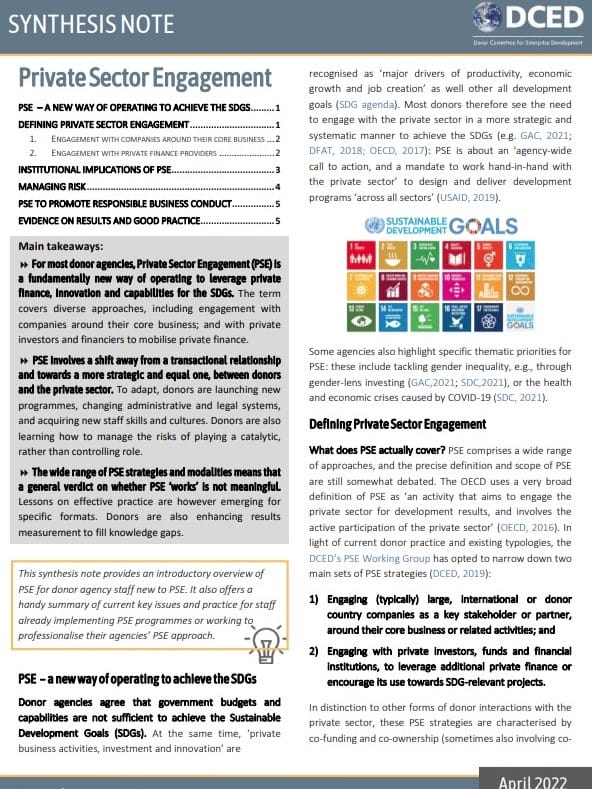
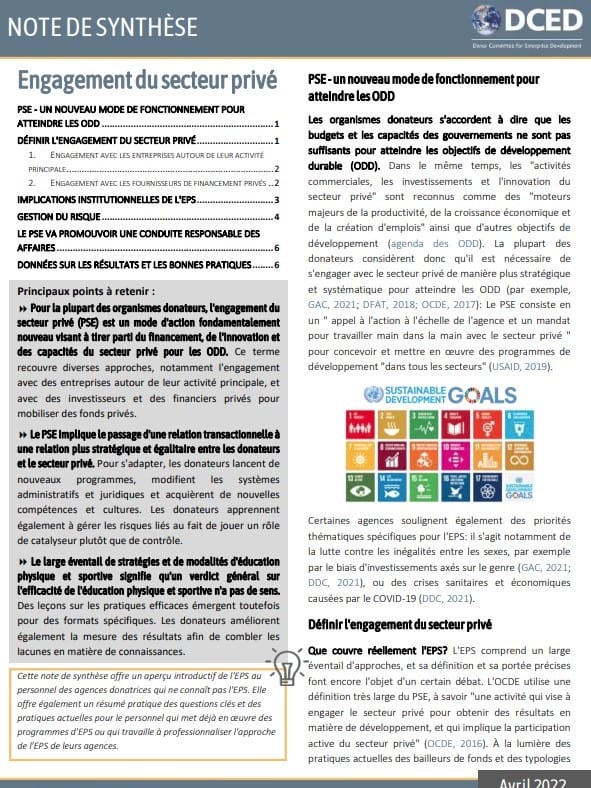
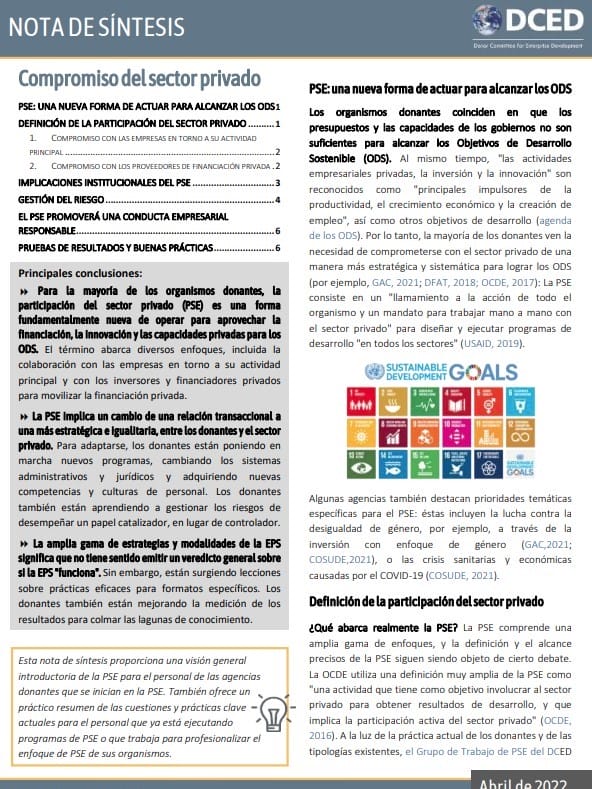
The OECD has proposed a broad definition of PSE as ‘an activity that aims to engage the private sector for development results, and involves the active participation of the private sector’ (OECD, 2016). The DCED PSE Working Group in its Operational Framework (2019) focuses on two specific PSE strategies:
Engaging with companies on equal terms to enhance the impact of their core business on the SDGs, for example through the joint development and financing of SDG-oriented business models or dialogue platforms on responsible business practices. In contrast, other PSD approaches may involve or target the private sector as a beneficiary only.
Engaging with the financial sector, to mobilise private finance for development, e.g. through blended finance instruments.
The Working Group, established in 2017, is chaired by GIZ.
The group’s current focus is to contribute to the DCED’s learning agenda on how to achieve (and measure) mutual benefits for donor and partner countries, at the nexus of PSE, trade and other national interests. The group also continues to have a strong interest in organisational aspects and effective instruments of private sector engagement, and the interface with financial institutions – building on many years of facilitating peer exchange and learning sessions in the safe space of the group. Specifically, current activities include
Developing an shared, overarching Theory of Change on how PSE is expected to lead to development outcomes, alongside benefits for donor country partner businesses and economies.
Holding discussions on the impacts of the changing political landscape on PSE, and how to find synergies between development effectiveness considerations and national interests of donor governments.
Continuing to host peer learning sessions on organisational aspects of PSE; examples of recent topics include the creation of one-stop online portals to streamline agencies’ offer to businesses, and agency-wide reform initiatives to enable strategic PSE.
Sharing experiences in how donor agencies can enhance synergies and collaboration with DFIs in mobilising finance (a topic now being taken on by the DCED’s new SME Finance Working Group).
This website uses cookies to store information on your computer. You may block cookies from this site, but disabling cookies will prevent us from monitoring site usage which helps us make improvements to the site. Read more about how we use cookies.COOKIE SETTINGSACCEPT
Privacy & Cookies Policy
Privacy Overview
This website uses cookies to improve your experience while you navigate through the website. Out of these cookies, the cookies that are categorized as necessary are stored on your browser as they are essential for the working of basic functionalities of the website. We also use third-party cookies that help us analyze and understand how you use this website. These cookies will be stored in your browser only with your consent. You also have the option to opt-out of these cookies. But opting out of some of these cookies may have an effect on your browsing experience.
Necessary cookies are absolutely essential for the website to function properly. This category only includes cookies that ensures basic functionalities and security features of the website. These cookies do not store any personal information.
Any cookies that may not be particularly necessary for the website to function and is used specifically to collect user personal data via analytics, ads, other embedded contents are termed as non-necessary cookies. It is mandatory to procure user consent prior to running these cookies on your website.