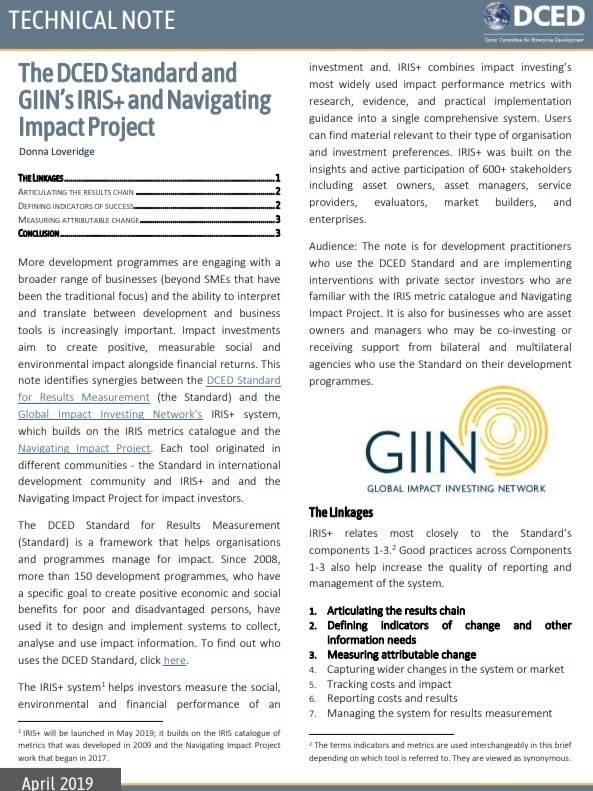
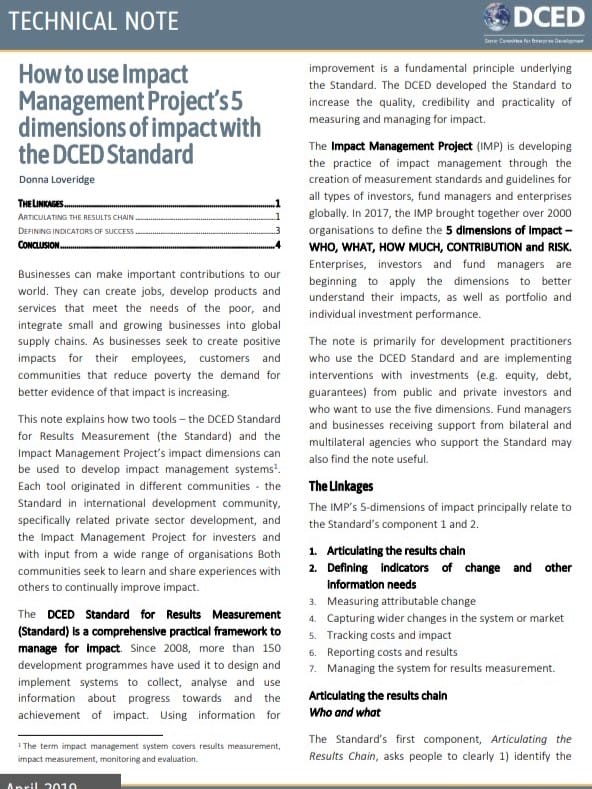
Good results measurement is a priority for all members of the DCED, as it generates the evidence base to assess the effectiveness of private sector development and feedback into learning and adaptive management. The Results Measurement Working Group (RMWG) was therefore formed in 2008 to identify ways in which the DCED can contribute meaningfully to improving practice on the ground, at scale.
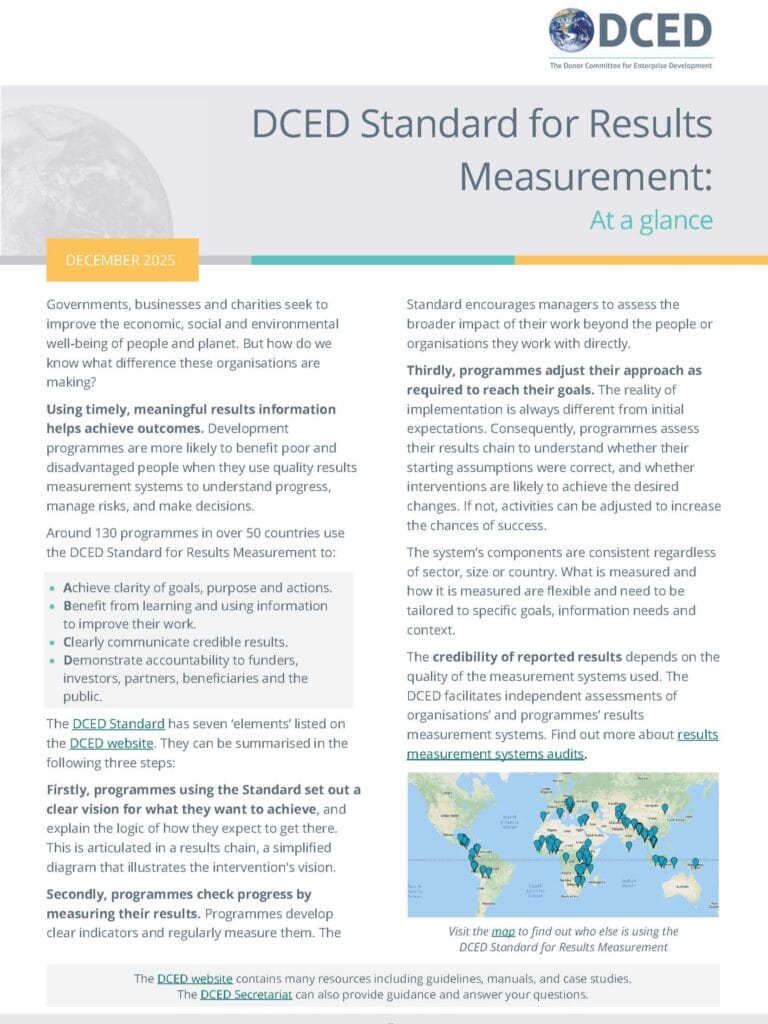
One element emerging in response to this question was to codify good-practice monitoring, using a mixed-methods, theory-based approach (‘the DCED Standard for Results Measurement’), which provides programmes with the framework to monitor their own results according to good practice. The Group supervised the development of the Standard and focused on putting in place an extensive system of support and incentives to enable the implementation of the approach on the ground. Credibility is assured through external audit of the measurement process.
A second element has been to work with members to identify common indicators widely used in private sector development projects, and to short-list and document the application of the most popular ones.
The RMWG also aims to explore other priority themes of members with the view to contribute to the improvement of results measurement (see the current priorities below).
Supporting results measurement of ‘green’ PSD programmes that aim to support positive environmental outcomes, climate adaptation and resilience and/or climate change mitigation: This includes an ongoing assignment to develop case studies on the measurement of ‘green’ outcomes of PSD programmes and ties into wider DCED efforts to provide a framework for green PSD programming and measurement (see the DCED’s Theory of Change on green PSD, forthcoming).
Exploring how donor agencies might capture mutual benefits arising from PSD, in light of current political pressures to link aid to economic and other national interests of donor countries. Members of the RM WG and PSE WG have held several exchanges on current thinking and experiences, including at the 2025 Annual Meeting and a dedicated DCED-wide online meeting in November 2025.
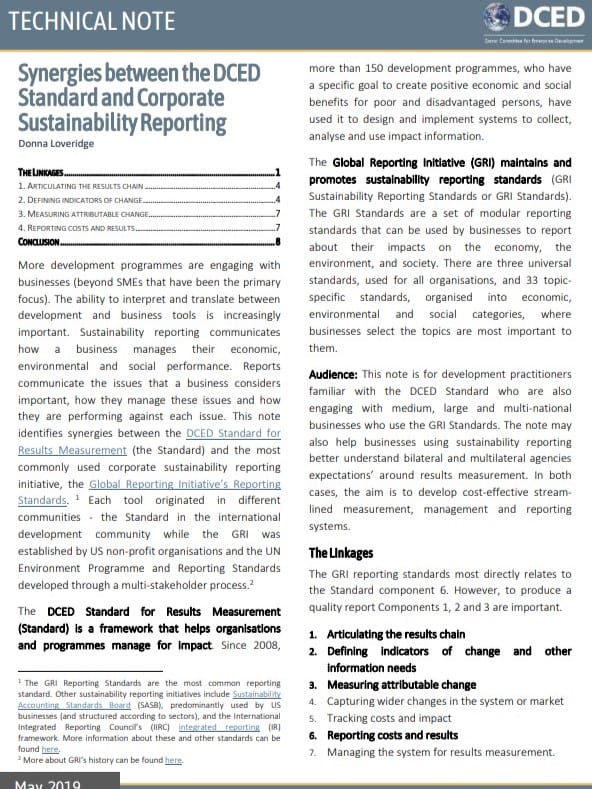
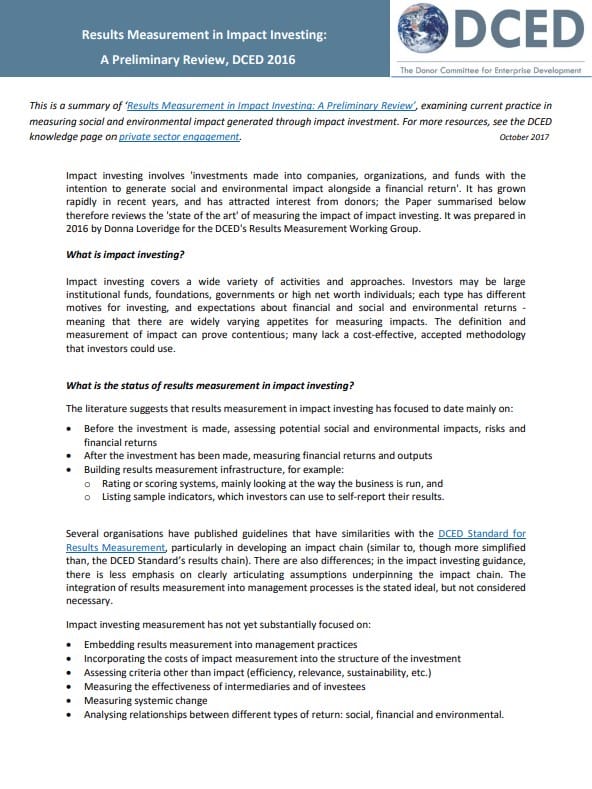
Exploring applications of good results measurement practices to the field of finance, in collaboration with the DCED’s new SME Finance Working Group. This includes an interest improving the quality of self-reported data by enterprises to help them attract finance. Earlier work of the Group reviewed Results Measurement in Impact Investment (2016), which surveys results measurement work of the impact investing and social enterprise communities.
Continuing to support member agencies’ efforts towards credible results measurement, and ultimately contributing to expanding the evidence base for PSD. As such, the group continues to support the roll-out of the DCED Standard for Results Measurement through further guidance and training for practitioners and auditors, organising audits, and through further dissemination among DCED members. Members are invited to contact the Secretariat for advice and support on good measurement practices and the application of the Standard.
This website uses cookies to store information on your computer. You may block cookies from this site, but disabling cookies will prevent us from monitoring site usage which helps us make improvements to the site. Read more about how we use cookies.COOKIE SETTINGSACCEPT
Privacy & Cookies Policy
Privacy Overview
This website uses cookies to improve your experience while you navigate through the website. Out of these cookies, the cookies that are categorized as necessary are stored on your browser as they are essential for the working of basic functionalities of the website. We also use third-party cookies that help us analyze and understand how you use this website. These cookies will be stored in your browser only with your consent. You also have the option to opt-out of these cookies. But opting out of some of these cookies may have an effect on your browsing experience.
Necessary cookies are absolutely essential for the website to function properly. This category only includes cookies that ensures basic functionalities and security features of the website. These cookies do not store any personal information.
Any cookies that may not be particularly necessary for the website to function and is used specifically to collect user personal data via analytics, ads, other embedded contents are termed as non-necessary cookies. It is mandatory to procure user consent prior to running these cookies on your website.